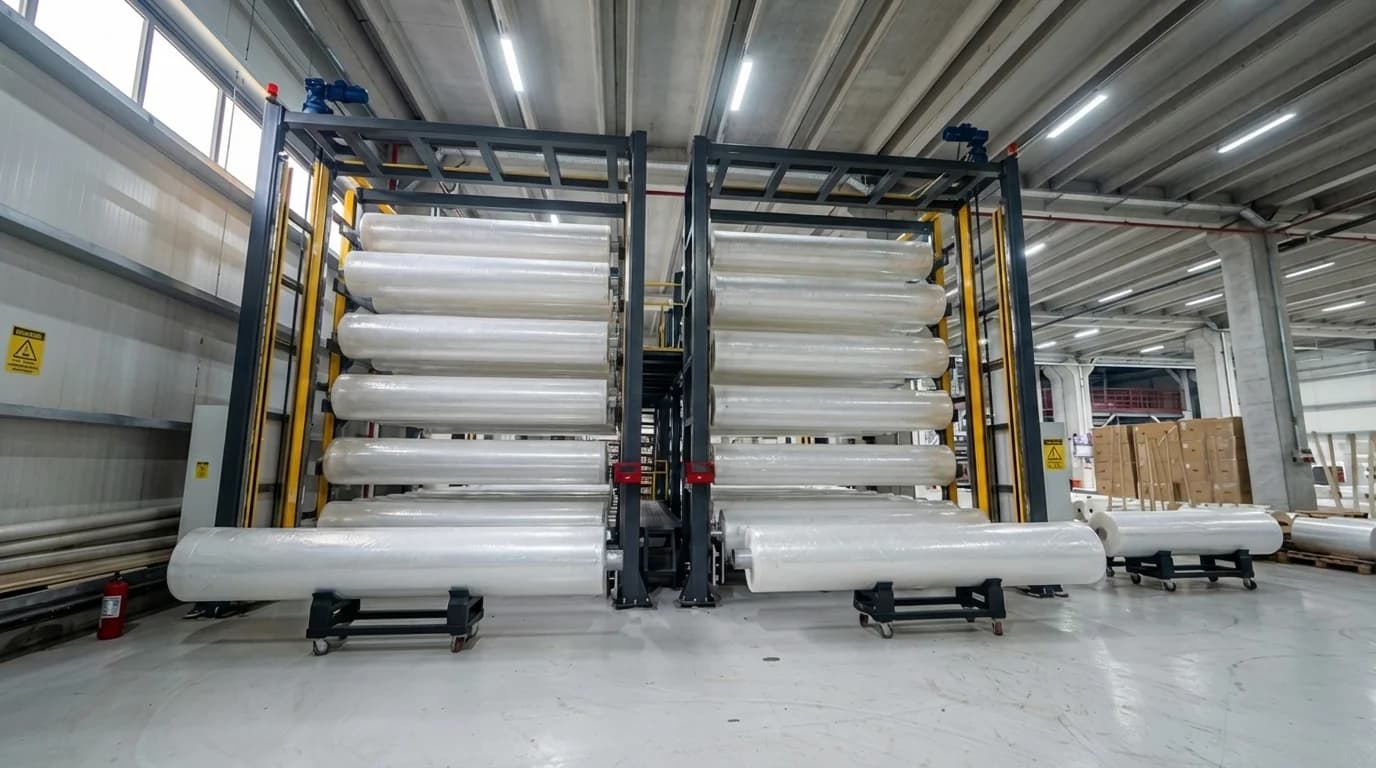
Sustainable POF Shrink Film
Sustainable POF Shrink Film:
Mono-Material, Recyclable
Mono-material polyolefin, no chlorine in the polymer. Every gram of production waste is granulated and fed back into the extruder line. Manufactured in Balıkesir — short overland delivery replaces long-haul sea freight, and FDA food-contact approval is the formal proof the chemistry holds up under shrink-tunnel heat.
Closed-Loop Production: A Zero-Waste Principle
At our Balıkesir facility, the 5-layer co-extrusion line generates the usual production by-products — edge trims from the slitter, start-up purge, off-spec rolls. None of it goes to a skip. Every gram is granulated on site and metered back into the extruder feed as raw material.
The closed loop means zero production waste leaves the building. Raw-material yield runs at the maximum the process allows, and the discipline doubles as a cost control. Environmental responsibility and unit economics happen to point in the same direction here.
Quality is not negotiated to make the loop work. Recycled feedstock returns at controlled ratios, and the 5-layer architecture preserves performance against spec. For applications that demand maximum optical clarity and full mechanical reserve, the Center-Fold PLUS format is available — 100% virgin polymer, zero recycled content.
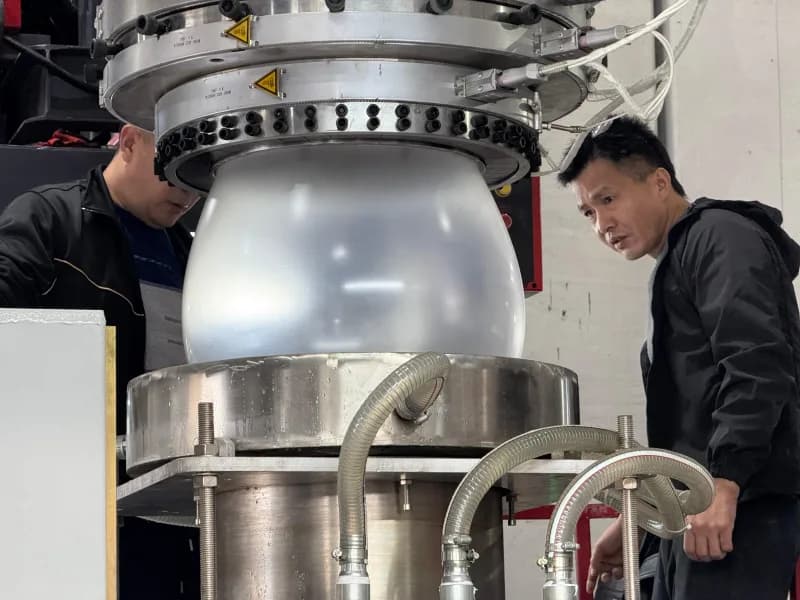
POF vs. PVC: Environmental Comparison
POF (polyolefin) shrink film is built from carbon and hydrogen atoms only. There is no chlorine in the polymer. That single chemical difference — present or absent in the molecule — sets the entire environmental profile apart from PVC.
| Criterion | POF (Polyolefin) | PVC |
|---|---|---|
| Chlorine content | 0% — chlorine-free | ~57% chlorine by mass |
| HCl emission (processing) | None | Yes — from ~210°C and up |
| HCl emission (combustion) | None | Yes — primary combustion product |
| Dioxin / furan formation | None — no chlorine precursor | Yes — especially in uncontrolled combustion |
| Complete combustion products | Only CO₂ + H₂O | CO₂ + H₂O + HCl |
| Shrink tunnel (130-180°C) | No harmful emissions | Toxic fumes, odor, carbon residue on seal jaws |
| Food contact approval | FDA approved | Restricted / limited |
| Recyclability | Yes — thermoplastic | Difficult — chlorine contamination |
Why It Matters
When POF burns, it produces no hydrochloric acid, no dioxin, no furan.
POF contains no chlorine atom in its molecular structure. That is a chemical fact, not a marketing claim. PVC, by contrast, is roughly 57% chlorine by mass and releases chlorinated compounds when burned — including hydrochloric acid and, under uncontrolled combustion, dioxin and furan. Browse the MGS POF product range.
Sustainability as a Core Value
Sustainability is not marketing copy at MGS — it is a constraint we design the production process around. Material selection, waste handling, energy use on the line, and logistics planning are each examined for environmental impact, and the answers we land on tend to be the practical ones rather than the slogan-friendly ones.
Choosing polyolefin was a deliberate decision: chlorine-free, recyclable as a thermoplastic, and approved for food contact. Capturing all production waste and feeding it back into the line cuts raw-material loss to zero. Manufacturing in Türkiye removes the long-haul sea-freight leg from the supply chain. Three pillars, working together — material, process, logistics.
Material Choice
Mono-material polyolefin with no chlorine in the polymer. Recyclable thermoplastic. No toxic gas during processing or end-of-life handling.
Zero-Waste Production
Every gram of production waste — edge trims, start-up purge, off-spec rolls — is granulated and fed back to the line. Nothing leaves the facility for landfill. Raw-material yield runs at the maximum the process allows.
Local Logistics
Distribution from Balıkesir into Türkiye and the surrounding region. Short overland delivery instead of long-haul sea freight. The carbon footprint of imported film, measured in container-weeks at sea, is cut to a fraction.
Frequently Asked Questions on Sustainability
What happens to production waste?
Every category of production waste — edge trims from the slitter, start-up purge, off-spec rolls — is granulated on site and metered back into the extruder feed as raw material. Nothing leaves the Balıkesir facility for landfill.
Does recycled material reduce quality?
On standard center-fold film, recycled feedstock returns at controlled ratios and the 5-layer architecture preserves performance against spec. For applications that demand maximum optical clarity and full mechanical reserve — premium retail, electronics, cosmetics — the Center-Fold PLUS format is available, made from 100% virgin polymer with zero recycled content.
Is POF shrink film recyclable?
Yes. POF is a polyolefin thermoplastic, processed in the same recycling stream as standard polyethylene. Because there is no chlorine in the polymer, recycling does not release chlorinated compounds, and the recovered material can re-enter packaging or other plastic streams cleanly.
Does POF release harmful gases when burned?
POF has no chlorine in the polymer, so combustion does not produce hydrochloric acid (HCl), dioxin, or furan. Under complete combustion, the only products are CO₂ and H₂O — the same as wood or natural gas. That is the fundamental separation from PVC, where chlorinated compounds are unavoidable combustion by-products.
Are there gas emissions in the heat tunnel?
At standard shrink-tunnel temperatures (130-180°C), POF film releases no harmful gases. PVC, by contrast, can release HCl at processing temperatures and leaves carbon residue on seal jaws — a maintenance and operator-health issue many lines have already migrated away from. POF's FDA food-contact approval is the formal proof that the chemistry holds up under shrink-tunnel heat.
How does local production support sustainability?
Imported film travels container-weeks across overseas shipping lanes — every shipment carries the carbon footprint of long-haul sea freight. MGS film ships from Balıkesir into Türkiye and the surrounding region by short overland delivery, which represents a small fraction of the long-haul carbon load. Faster lead times happen to be a side effect.
A Domestic Manufacturer for Sustainable Packaging
Mono-material polyolefin shrink film, chlorine-free and recyclable. Closed-loop production, no harmful gas during processing, and a logistics chain measured in days instead of container-weeks. Improve your supply chain on both economics and environmental metrics.