TDS Library
Full POF Shrink Film TDS,
ASTM-Verified and Ungated
Open access to MGS 5-layer co-extruded POF shrink film test data. Eight ASTM methods, four standard thicknesses (12, 15, 19, 25 µm) — 125 N/mm² tensile, ±0.75 µm tolerance, 5.300 cc/m²/day OTR on the 25 µm gauge. No download wall. No registration form. No sales call before you see the numbers.
Why We Publish TDS Data Openly
Across the shrink film industry, technical data sheets sit behind download walls, registration forms, or a mandatory call with a sales rep. That delay slows production-side benchmarking and pushes procurement decisions weeks past the point a buyer is ready to qualify a new supplier.
MGS publishes the data on this page. Every roll of 5-layer co-extruded POF shrink film produced at our Balıkesir facility is tested to ASTM methods, and the results live here — no form, no gate, no follow-up call required.
The tables below cover mechanical, optical, thermal, barrier, and physical properties across four standard thicknesses (12, 15, 19, 25 µm), each test referenced by ASTM number. Use this data to qualify the film against your incumbent supplier and to model performance on your shrink-tunnel and L-bar sealer line.
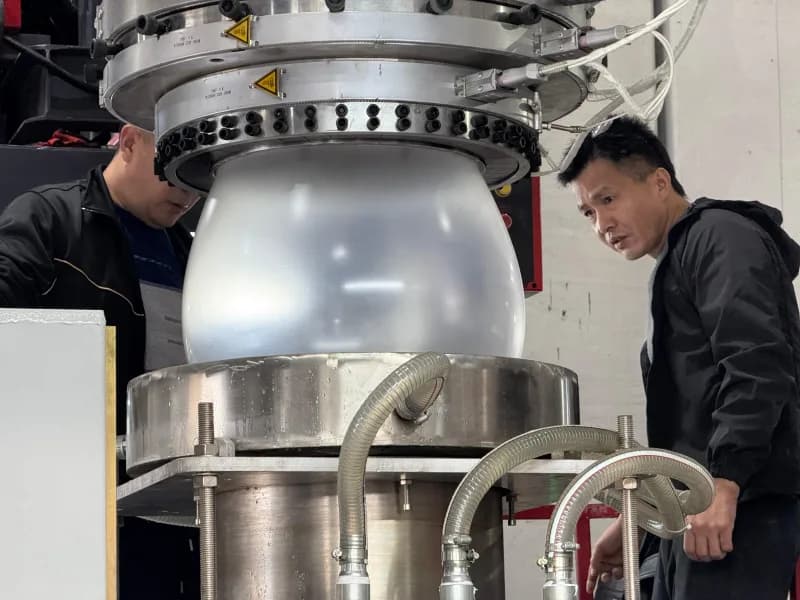
Balıkesir OSB — 5-layer co-extrusion line, 24/7 production
Test Coverage
Verified to ASTM Standards
MGS POF shrink film is qualified against eight ASTM methods accepted across the packaging industry — mechanical strength, seal performance, optical clarity, friction, free shrink, tear, and impact — measured separately for every thickness and format.
ASTM D882
Tensile Strength
Tensile strength and elongation
ASTM D1922
Elmendorf Tear
Tear resistance
ASTM D3420
Pendulum Impact
Impact resistance
ASTM F88
Heat-Seal Strength
Seal-bond peel test
ASTM D1003
Optical Clarity
Haze and light transmission
ASTM D1894
Coefficient of Friction
Static and dynamic COF
ASTM D2732
Free Shrink
Free shrink at temperature
ASTM D374
Thickness Gauging
Caliper and tolerance
POF Shrink Film Specifications by ASTM Method
All testing is performed against internationally accepted ASTM standards. Values are reported separately for each standard thickness (12, 15, 19, 25 µm).
Thickness and Tolerance
| Property | Test | Unit | 12 µm | 15 µm | 19 µm | 25 µm |
|---|---|---|---|---|---|---|
| Thickness Tolerance | ASTM D374 | µm | ±0.75 | ±0.75 | ±0.75 | ±0.75 |
| Core Inner Diameter | – | inch | 3 | 3 | 3 | 3 |
What This Test Measures
The base parameter for every other physical property. Measured by micrometer on every jumbo roll. A ±0.75 µm tolerance is the indicator that the line stays calibrated across a production shift.
Mechanical Properties (Tensile Test)
| Property | Test | Unit | 12 µm | 15 µm | 19 µm | 25 µm |
|---|---|---|---|---|---|---|
| Tensile Strength (MD) | ASTM D882 | N/mm² | 125 | 120 | 110 | 115 |
| Tensile Strength (TD) | ASTM D882 | N/mm² | 130 | 125 | 115 | 120 |
| Elongation at Break (MD) | ASTM D882 | % | 105 | 110 | 110 | 115 |
| Elongation at Break (TD) | ASTM D882 | % | 105 | 110 | 115 | 122 |
What This Test Measures
Confirms the film stretches without breaking through the line. MD (machine direction) and TD (transverse direction) are tested separately — a built-in result of the double-bubble co-extrusion process. Seven specimens are cut from every two jumbo rolls, with a minimum 5/7 pass criterion.
Heat-Seal Strength
| Property | Test | Unit | 12 µm | 15 µm | 19 µm | 25 µm |
|---|---|---|---|---|---|---|
| Heat-Seal Strength | ASTM F88 | N/15mm | 9 | 10 | 12 | 15 |
What This Test Measures
Confirms heat-seal seams hold under load. Tested on every shipment — the single parameter most tied to end-user satisfaction. Low seal strength is the leading cause of pack opening and return claims.
Coefficient of Friction (COF): Film-on-Film
| Property | Test | Unit | 12 µm | 15 µm | 19 µm | 25 µm |
|---|---|---|---|---|---|---|
| Static COF | ASTM D1894 | – | 0.32 | 0.30 | 0.25 | 0.25 |
| Dynamic COF | ASTM D1894 | – | 0.32 | 0.30 | 0.25 | 0.25 |
What This Test Measures
Controls how the film slides through automatic packaging machines. Measures slip-additive migration — a low COF lets the film travel through the machine without grabbing. Sampled three times per production day.
Optical Properties
| Property | Test | Unit | 12 µm | 15 µm | 19 µm | 25 µm |
|---|---|---|---|---|---|---|
| Haze | ASTM D1003 | % | 3.0 | 3.5 | 4.0 | 4.5 |
| Clarity | ASTM D1003 | % | 92.5 | 92.0 | 92.0 | 91.5 |
What This Test Measures
Drives shelf appearance and product visibility. Low haze means a clear film; high clarity means a sharp product reading through the wrap. Optical values are a direct readout of resin purity and line cleanliness.
Free Shrink Performance
| Property | Test | Unit | 12 µm | 15 µm | 19 µm | 25 µm |
|---|---|---|---|---|---|---|
| Free Shrink (100°C) — MD | ASTM D2732 | % | 22 | 21 | 18 | 17 |
| Free Shrink (100°C) — TD | ASTM D2732 | % | 31 | 30 | 28 | 26 |
| Free Shrink (120°C) — MD | ASTM D2732 | % | 60 | 58 | 57 | 56 |
| Free Shrink (120°C) — TD | ASTM D2732 | % | 62 | 61 | 60 | 59 |
100°C: ASTM D2732 (liquid bath, 10 sec). 120°C: ASTM D2732 (air, 10 min).
What This Test Measures
Simulates shrink-tunnel performance. The 100°C test (liquid bath, 10 sec) is the daily production-control parameter. The 120°C test (air, 10 min) shows maximum shrink capacity. TD always exceeds MD — a built-in result of the double-bubble blowing process.
Barrier Properties (OTR / WVTR)
| Property | Test | Unit | 12 µm | 15 µm | 19 µm | 25 µm |
|---|---|---|---|---|---|---|
| Oxygen Transmission Rate (OTR) | ASTM D3985 | cc/m²/day | 12.500 | 10.000 | 7.500 | 5.300 |
| Water Vapor Transmission Rate (WVTR) | ASTM F1249 | gm/m²/day | 45 | 37.5 | 27 | 23 |
What This Test Measures
OTR (Oxygen Transmission Rate) drives food shelf life through oxygen ingress; WVTR (Water Vapor Transmission Rate) protects product in humid storage. Thicker film equals stronger barrier — a critical parameter for food, cosmetics, and pharmaceutical packaging.
Thickness Selection Guide: Which Micron for Which Application?
Film thickness is the single biggest variable in pack performance. Specifying the right gauge cuts material waste and lifts machine throughput.
| Thickness | Typical Application | Recommended Pack Weight |
|---|---|---|
| 12 µm | Light items: CD/DVD, small cartons, cosmetics | Up to 100 g |
| 15 µm | Food cartons, pharmaceutical boxes, mid-size items | 100–500 g |
| 19 µm | Heavier cartons, multipacks, industrial parts | 500 g – 3 kg |
| 25 µm | Heavy industrial goods, pallet-top bundling | 3 kg and above |
Note: recommended weights are general guidance. For application-specific qualification, consult the MGS technical team.
Perforated Film Options
Every thickness can ship in a perforated format. MGS offers three perforation types: hot-perforated (regular micro holes formed by heated needles), macro-perforated (large hole diameter, high air permeability), and micro-perforated (controlled-breathability micro holes). Perforated films are the standard pick for fresh produce, bakery, and deli packaging. See perforated film product details.
5-Layer Co-Extruded Film Structure
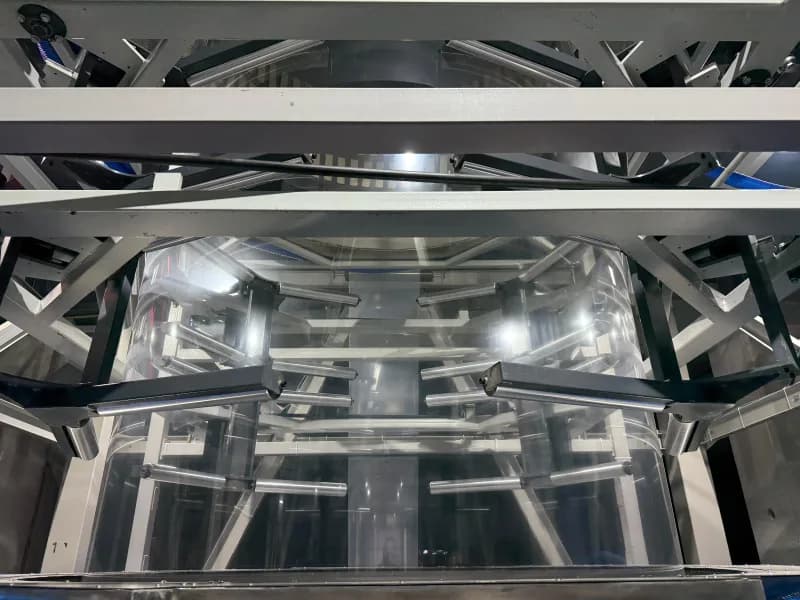
MGS POF shrink film is produced through 5-layer co-extrusion technology. Assigning a different polymer to each layer lets us optimize mechanical strength, optical clarity, and shrink performance independently — instead of compromising one to gain another.
POF vs PVC: Where the Differences Sit
Machine Compatibility
Calibrated With Our Partner
Maripak's Machine Expertise
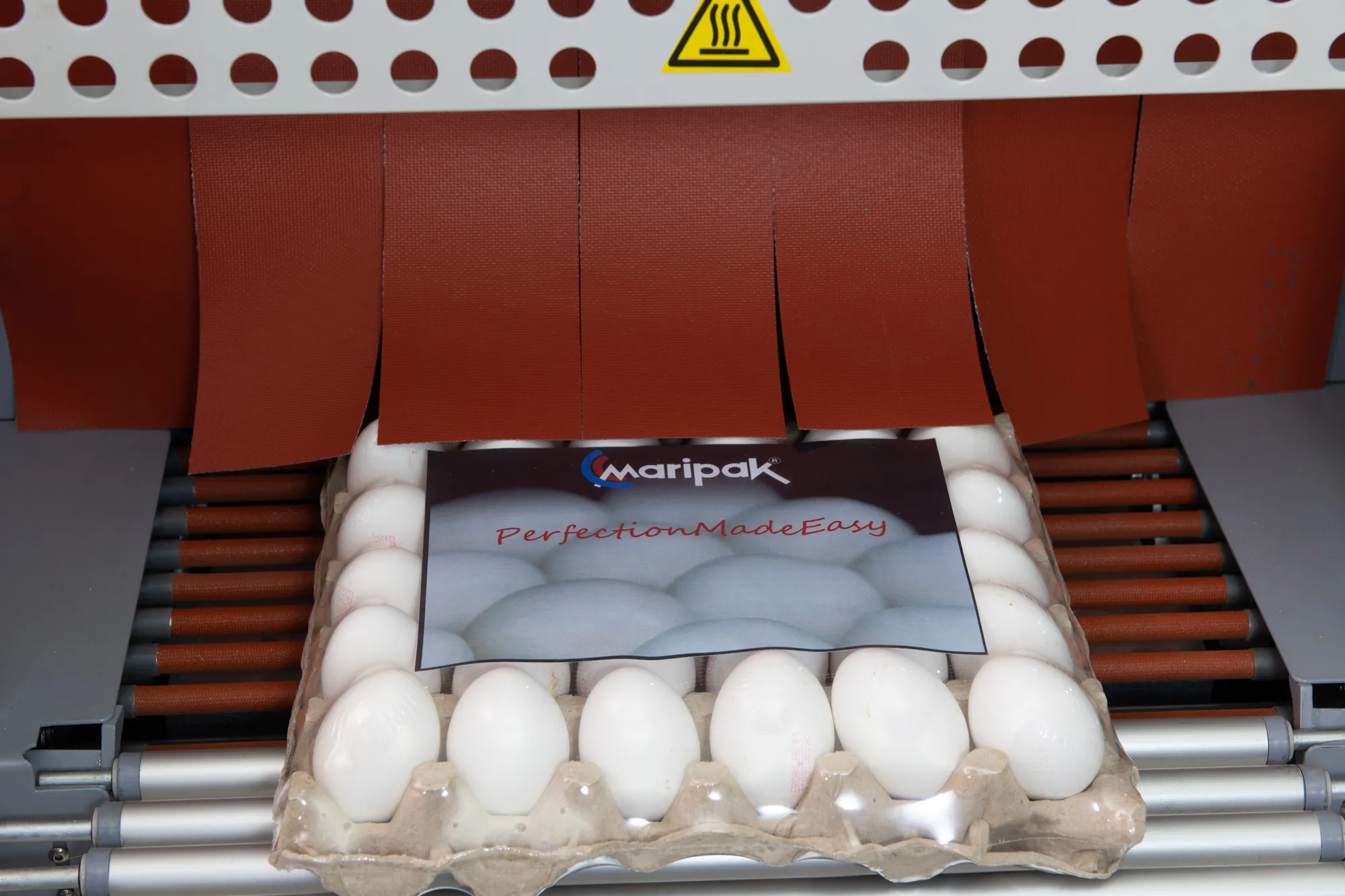
MGS makes the film. Our partner Maripak makes the shrink-packaging machines — Turkey's number-one machine builder since 1989, with 500 machines per year and distribution into 40+ countries. Two separate companies, one factory floor: every roll we produce is run through real Maripak shrink tunnels before it ships, so machine compatibility is verified before the truck leaves.
Maripak is independently owned and operates separately from MGS. The partnership gives our customers something the rest of the import market can't offer — film engineered with direct access to the machine builder's tunnel data, dwell-time profiles, and L-bar sealer behavior. See machine compatibility details.
POF Shrink Film Specifications: Frequently Asked Questions
What ASTM test data is published for MGS POF shrink film?
MGS 5-layer co-extruded POF shrink film is tested against eight ASTM methods: D882 (tensile strength and elongation), F88 (heat-seal strength), D1894 (coefficient of friction), D1003 (haze and clarity), D2732 (free shrink), D374 (thickness gauging), D3985 (oxygen transmission rate), and F1249 (water vapor transmission rate). Every result is reported separately for the four standard thicknesses on this page, with no download wall.
How does POF shrink film differ from PVC technically?
POF film is roughly 30% lighter than PVC per square meter (0.92 vs 1.30 g/cm³), runs higher optical clarity, and contains no chloride — so heat-sealing through a tunnel does not release the harmful gases associated with PVC welding. PVC remains compliant for unheated food contact; the difference shows up under heat.
Which thicknesses does MGS produce in POF shrink film?
MGS produces 5-layer co-extruded POF shrink film in four standard thicknesses: 12, 15, 19, and 25 micron (µm). 30 µm is available on request. ASTM test data for each standard thickness is published on this page.
What is the difference between the 100°C and 120°C free shrink tests?
100°C free shrink (ASTM D2732, liquid bath, 10 sec) is the daily production-control test and the closest match to real shrink-tunnel conditions. 120°C (air, 10 min) shows maximum shrink capacity. Both are reported separately for MD and TD because the double-bubble process produces different shrink behavior in each direction.
How do I get the full TDS in PDF form?
Every ASTM test value on this page is openly published — no download wall, no registration form. For the full PDF TDS package or a thickness-specific data sheet, email sales@mgsfilms.com or submit a request through our contact page; the technical team responds the same business day.
What does ASTM D882 measure?
ASTM D882 is the standard test method for tensile strength and elongation at break in thin plastic films. Specimens are cut in both machine direction (MD) and transverse direction (TD), seven strips per direction. MGS applies a minimum 5/7 pass criterion — a single failed strip out of seven is acceptable; two failures send the lot back for re-test.
What do OTR and WVTR mean for packaging?
OTR (Oxygen Transmission Rate, ASTM D3985) measures the film's oxygen barrier; WVTR (Water Vapor Transmission Rate, ASTM F1249) measures its moisture barrier. Both drive shelf life and product protection in food, cosmetics, and pharma applications. Thicker film equals stronger barrier — the 25 µm gauge runs OTR 5.300 cc/m²/day, while the 12 µm gauge sits at 12.500 cc/m²/day.
MGS Production Infrastructure
The Next Step
After the data review, the most reliable evaluation is a sample roll run on your own line. Pick the path that fits where you are in the qualification cycle.